In October 2025, local body elections across Aotearoa included a poll on whether Māori Wards in Councils should be retained. Māori Wards sit alongside General Wards and allow voters on the Māori roll to elect a representative to their local council.
It is well established that Māori Wards lead to better decision making which benefits all in our communities. Waikato District Council (WDC) has two Māori Wards.
Across Aotearoa, poll results saw 17 councils keep their Māori wards, and 25 councils lose them. Unfortunately, WDC did not retain their Māori Wards. This means that from 2028, the two WDC Māori Wards will no longer exist.
Although a very disappointing outcome, there are pockets of hope. When looking at how people from Aotearoa voted as a whole, there were more people who voted to keep Māori Wards (52%) than those who voted to remove them (48%). Research from social justice advocacy group Action Station shows major shifts in support for Māori Wards over the past decade: people are changing their views on the role of Te Tiriti and te ao Māori on local councils.
The Whaingaroa community also stands out as a beacon of hope. WDC data shows that the Whaingaroa Raglan Ward was the only Ward in the entire WDC area (aside from the existing Māori Wards) to have voted ‘Yes’ to Māori Wards. And they did so by a significant majority.
So, what was happening in Whaingaroa?
Without a doubt, a key part of voting patterns in Whaingaroa was the flax-roots ‘Keep Our Māori Wards’ campaign. Motivated by a desire to strongly oppose government attacks on Te Tiriti o Waitangi and local decision-making, on Saturday August 23rd long-time locals Tony and Linda Mayow took to the grass median strip in the main street.
Armed with badges and signs provided by Taurikura NZ and the Len Reynolds Trust, Tony and Linda spent an afternoon sharing information and advocating for the retention of Māori Wards.
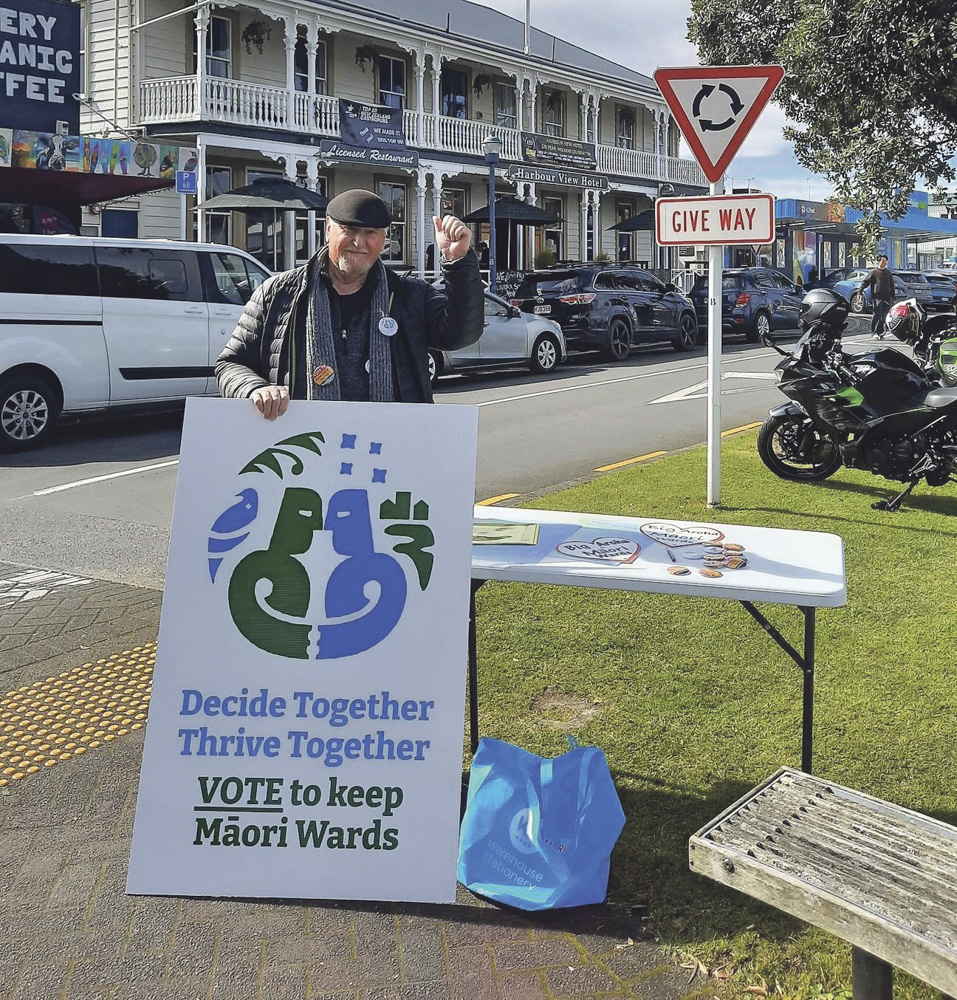
Tony says, “The first time I went out I didn’t know what was going to happen. But I was absolutely overwhelmed by the positivity of people driving past and people coming across the crossing. People were smiling and started taking the badges. And suddenly it was just all on.”
Tony posted photos and a call-out for more volunteers to the Toitū Whaingaroa Facebook group. Before long a group of 25+ dedicated volunteers (and their dogs!) had signed up to help get the message out.
An online spreadsheet was developed, making it easy for volunteers to sign up for shifts, and the group easily became self-administering. People regularly reported back to the Facebook group on their experiences, encouraging others to join. “People came with their friends and that’s how we recruited,” says Tony.
For two months, volunteers were in the centre of town and other places people congregated. In all weather they held signs, answered questions, and shared information – keeping the simple message visible – Vote Yes to Keep Our Māori Wards.
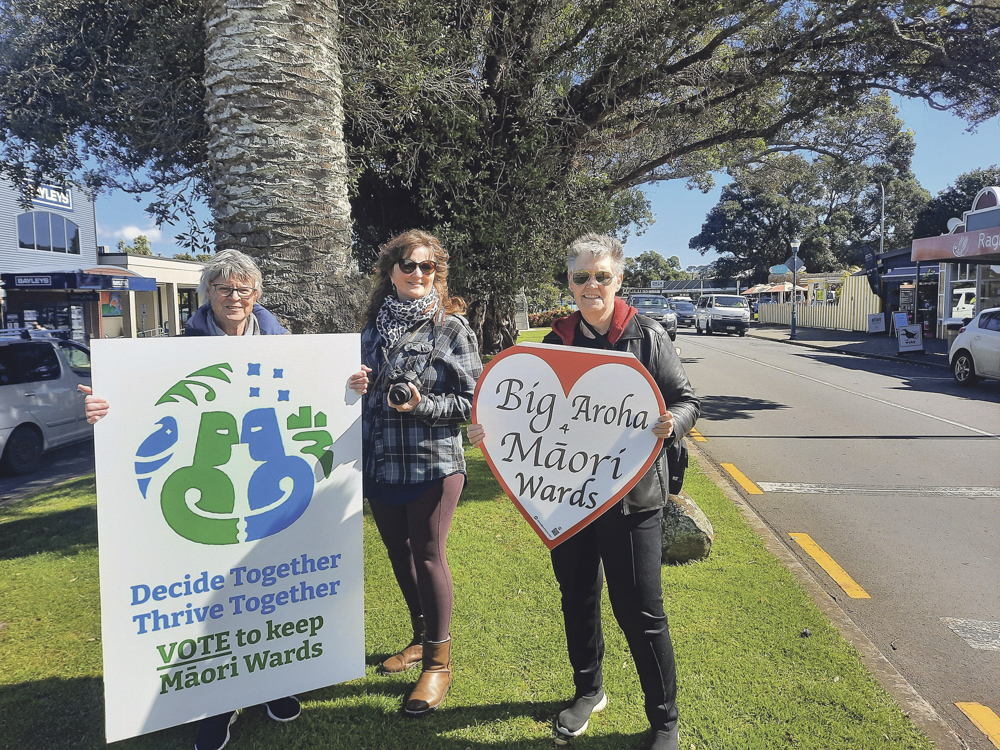
Volunteer Leanne Steel was part of the Māori Wards campaign because it was an opportunity to “communicate to all parts of our community the importance of a truly shared partnership where everyone is on an even playing field.” Similarly, Moira Cursey joined the campaign to share how “dedicated Māori Wards, by including tangata whenua knowledge and views, add richness to local government decision making.”
The reach of the campaign expanded further with interviews on Raglan Radio and articles in The Chronicle. Businesses came on board and displayed signs in their windows. “Bit by bit, building things up, keeping that momentum up. That really worked.” says Tony.
The Māori Wards campaign did not exist in isolation. Tony reflects how, “The interviews on Raglan Radio with myself, and Phil and Jilliene Beale arose because of the last Waitangi Day. I knew a number of Pākehā had been through the Tangata Tiriti workshops. So, I contacted Gabrielle Parson who had hosted the workshops as part of her mahi with Raglan Naturally and she helped to spread the word. Everything is connected. Building momentum, piece by piece, person by person. It’s all foundational stuff.”
The positive community response to the Māori Wards campaign was also intricately linked to other work in the community, “We didn’t get a lot of pushback and nastiness. I think that was because of all the work that had been done before. I don’t think anybody found it a great surprise that we were out there,” says Tony.
The Keep our Māori Wards campaign was constantly profiled on social media, with people encouraged to kōrero with their family, friends, and workmates. For Tony, “it gave Pākehā a chance to actually do something. There’s a huge well of goodwill out there, but people don’t often know what they can do. And this gave them a ‘thing’ to do.”
Volunteer Moira Cursey echoes this view. Being part of the campaign “was a positive way of honouring Te Tiriti o Waitangi, and a way of heightening awareness in the community of the existence and contribution of Māori Wards,” she says.
The campaign led to wider community activation. Any opportunities for information sharing were taken. Conversations about Māori Wards were happening with courier drivers as packages were delivered, during exercise classes and dog walks. Photos were shared of ways in which the community as individuals, groups, and organisations were showing their support. The underlying message was every action, big or small, mattered.
Whilst the overall result was not what was hoped for in terms of WDC retaining their Māori Wards, much was learnt about the power of flax-roots activation and its impact. Every sign waving session, email sent, sign put on a fence, social media post made, chats had, encouragement and advice given – it all made a difference in our community.
Despite involvement in the Māori Wards campaign being a “no-brainer” for Tony, he did not initially envisage being the one to lead it. After talking for some time with people about the need for someone to run the campaign, Tony eventually realised he was that person. “It was a lot easier than I thought it might be. That’s important. People need to understand that getting involved is not a difficult thing. It’s just a ‘do it’ thing. Lots of times we over-think things and get caught up in the ‘what-ifs’. Just do something.”
For anyone thinking of ‘doing’ something, Tony has some advice; “Three things are key – simplicity, face-to-face, and being happy. We didn’t need to enter into huge debates. We weren’t attacking anybody. We were just saying ‘we support Māori Wards’. We’re Pākehā and here we are with our banners. Just go down there and see what happens. It was as simple as that.”
The success of the ‘Keep Our Māori Wards’ campaign showed the Whaingaroa community is committed to Te Tiriti o Waitangi. The story of the campaign is important to remember as we head into 2026, with a critical general election happening. Together we are always stronger. Toitū Whaingaroa.
If you are interested in Te Tiriti o Waitangi learning opportunities in Whaingaroa send an email to michelle@raglannaturally.co.nz