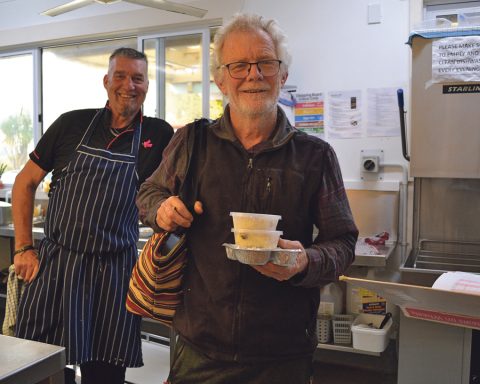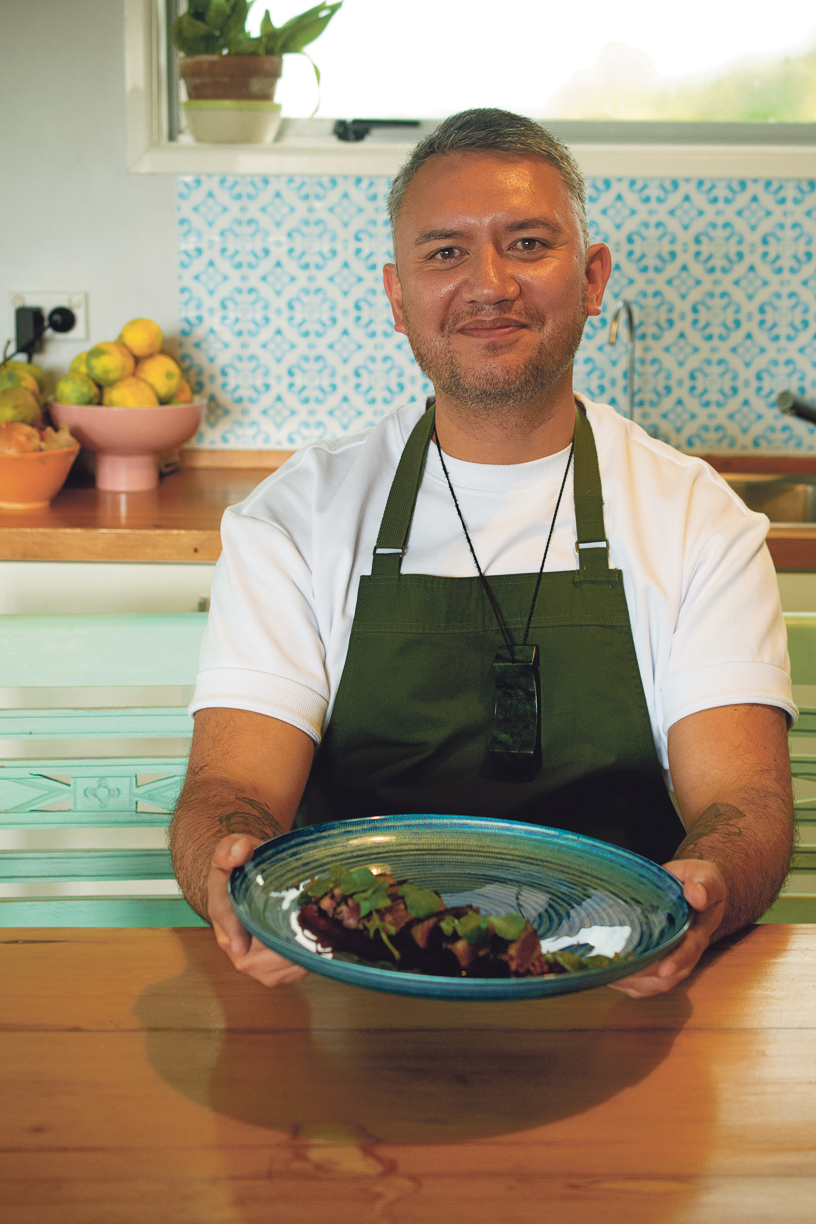
Local chef, community leader and mental health advocate Michael Edmonds has spent a lifetime understanding that kai has the power to connect people, strengthen communities and express care in ways words sometimes cannot. I asked Mike to introduce himself.
Tēnā koutou katoa, ko Karioi tōku maunga, ko Whāingaroa tōku moana, ko Poihākena rāua ko Tūrangawaewae ōku marae. He uri tēnei nō Ngāti Koata, Ngāti Mahuta me Ngāti Naho. Ko Tainui tōku waka. Ko Tainui o Tainui tōku iwi. E noho ana au ki Whāingaroa. Ko Mike Edmonds ahau.
Passionate about serving his community, whānau and iwi, Mike lives on his tūpuna whenua at Te Kōpua with his partner and describes himself as someone driven by “all things kai, from gathering, growing, harvesting, diving and hunting”.
His love of food has taken him around the world. Today he operates Karioi Katering, a business that grew from his passion for kai and recently catered for the World Surf League. Alongside this, he works in mental health and addictions and serves on several local, regional and international governance boards.
Yet despite the many hats he wears, his motivation remains simple.
“What keeps me involved in serving and supporting the community is a strong sense of responsibility to give back and contribute to the wellbeing of our people.”
Working in community health has reinforced his belief that change comes from culturally grounded support and genuine connection.
“I’m particularly motivated by creating spaces and programmes that reflect our values, uphold mana, and support long-term wellbeing rather than just short-term fixes.”
Some of his earliest memories are rooted in the traditions of gathering and sharing food.
“I like to think how fortunate I have been throughout my life, being surrounded by kai gardens, hunters and gatherers feeding thousands of people at Tūrangawaewae Marae.”
Family trips to Kaiaua Beach to gather seafood and time spent processing hunted meat on the family farm taught him early lessons about food sovereignty, generosity and collective care.
The greatest influence on his culinary journey was his grandmother, Te Rongopai Tāwhiao, a trained chef who worked at Hopuhopu Military Camp during the 1960s before running the kitchen at Tūrangawaewae Marae. He recalls watching her prepare meals for thousands of visitors before returning home to cook dinner for her own whānau. One of her food lessons still makes him laugh.
“Always leave one ingredient out of your recipes when sharing with others, so they don’t make it as good as you did – if you know my nan this is definitely her!”
But it was another lesson from his nan that truly stayed with him.
“Cook with love in your heart as you can taste it through your kai.”
His professional food journey took him across the Tasman, where he completed a chef’s apprenticeship in Australia and worked in some of Sydney’s finest restaurants.
Although he enjoyed the creativity and discipline of professional kitchens, he eventually chose to leave the industry and continue learning on his own terms. Food became a passport to different cultures and ways of seeing the world.
“I have a fond memory of an elderly Thai lady teaching me Thai food when I lived in Chiang Mai, Thailand, definitely my favourite cuisine.”
These days he enjoys preparing kaimoana and Southeast Asian dishes, cuisines that celebrate freshness, balance and generosity.
“Kaimoana has a strong connection to place, whānau, and gathering, while Southeast Asian and Thai dishes bring bright flavours, fresh herbs, spice, and balance that make meals feel special and memorable.”
Beyond nourishment, kai plays a central role in connection, culture and identity.
“Preparing and sharing kai creates space for kōrero, strengthens relationships, and helps people feel valued and cared for.”
For Mike, food is healing. It supports not only physical wellbeing but also wairua, belonging and the expression of manaakitanga.
“If we break the word down, ‘Mana ā ki tangata’, ‘To uplift the mana of a person’.”
Whether through health services, community initiatives or a shared meal, he believes support should always uphold dignity, kindness and respect. When neighbours, whānau or the wider community sit down to eat together, it builds belonging and a sense of care that goes beyond the meal itself.
It’s one reason he believes Whāingaroa is such a special place.
“There is a real culture of looking out for one another, sharing what is available, and stepping in when someone needs support. People often know each other through whānau, work, marae, sport, or local kaupapa, so sharing resources feels personal and collective rather than transactional. That creates a strong sense of belonging and responsibility to each other.”
As Matariki arrives, many New Zealanders gather to remember loved ones, celebrate the present and look to the future. For Mike, the season offers something deeply personal.
“Matariki, for me, is a deeply grounding time to pause, remember, and realign myself with the kaupapa that matters most in my life and mahi. It is a time to honour those who have passed and acknowledge the ways their influence continues to shape our lives. It reminds me that true hauora is woven through relationships with whānau, whenua, and moana.”
Growing up, Matariki wasn’t marked by large celebrations.
“It wasn’t really a focal point for my whānau growing up. We just knew that this was a time for reflection, wānanga, spending time with each other.”
Today, he sees Matariki as more than a public holiday. It is a framework for community wellbeing, leadership and collective reflection.
“It feels like a natural ‘reset point’ in the year where I can check in on my kaupapa, realign priorities, and set clear intentions. It’s a season that invites me to pause and honour those who have passed, to reflect on their impact on my life and mahi, and to carry their legacy into the way I lead and serve in Indigenous health and social services. At the same time, it reconnects me with mātauranga Māori and the rhythms of maramataka, reminding me that our wellbeing is inseparable from whenua, moana, and the cycles of the environment.”
Food sits at the heart of Matariki celebrations.
“During Matariki, kai plays the role of both sustenance and storytelling.”
Gathering around a table or at the marae allows people to remember those who have passed, celebrate those who are present and strengthen relationships.
Most importantly, Matariki reminds us that community is built through everyday acts of generosity.
“These are really challenging and uncertain times, everything is more expensive, cost of living has increased, but you are not alone! Taking a moment to share, support, reflect and awhi someone else, this helps build community, one of our greatest strengths in Whāingaroa.”
As our conversation came to an end, he offered one final reflection that captures both his approach to food and his hopes for the community.
“If readers take anything from my view, I hope it’s this: you don’t have to do anything grand to honour Matariki and strengthen community. Start with a simple meal, offered with genuine care, and let that be the place where remembrance, connection and hopeful planning begin.”
Perhaps that is the real lesson at the heart of Mike’s food journey. Kai is never just food. It is whakapapa, culture, care and community served at the same table.