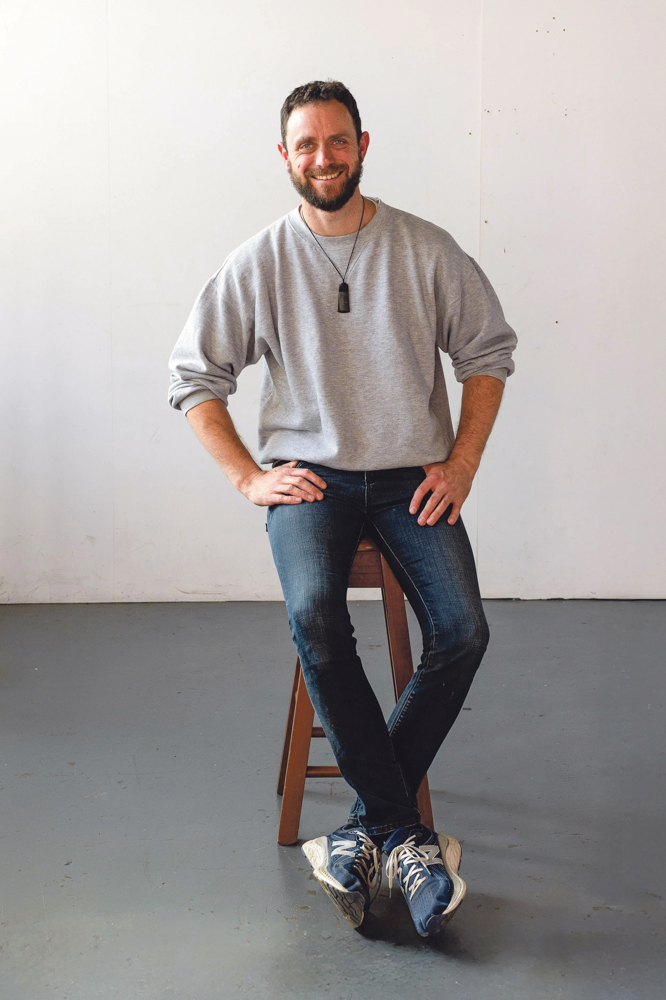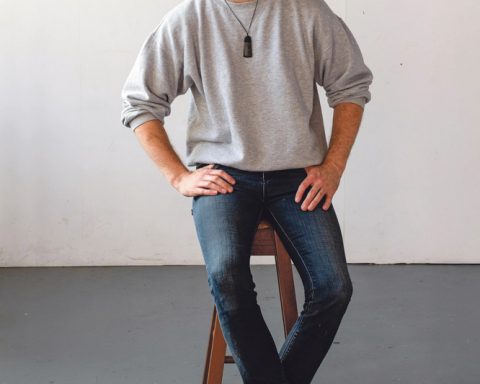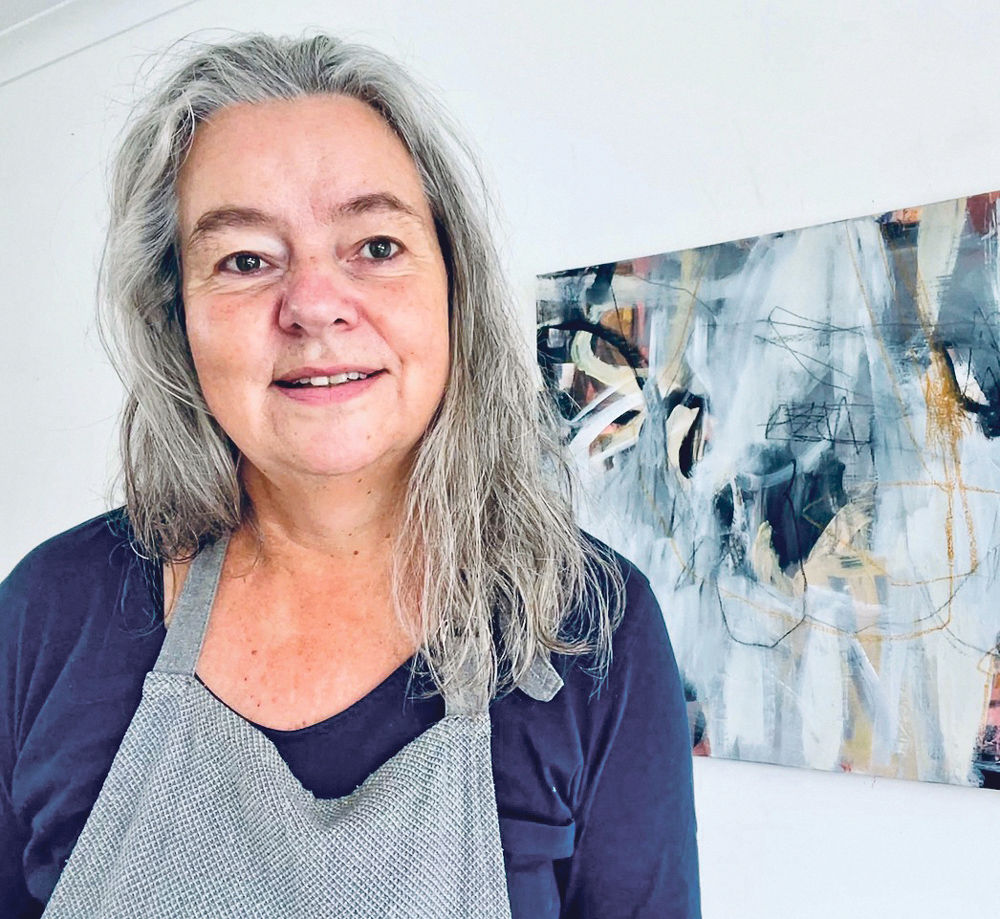
Working primarily in abstraction, this Raglan-based artist explores emotion, atmosphere and memory through a process-led practice rooted in play and intuition. Claudia Grutke’s work favours feeling over form, allowing meaning to emerge gradually rather than be prescribed.
How would you describe your art or style to someone seeing it for the first time?
My work could be described as abstract interpretations of emotional landscape paintings, where a feeling might be more inspirational than a visual object.
What inspires your work?
Since I started to look within, I am slowly realising that my inspiration predominantly arrives from intangible or vague subjects like atmosphere, nuances, undertones, movements, resonances, light and shade.
Conversations often spark something unexpected; memories can be brought up and ideas may follow.
Can you tell us about your creative process — where does an idea usually begin for you?
My work is driven by curiosity, without a fixed starting point or a defined destination. I love experimenting and generally find my way as I go.
In my studio, I give myself permission to playfully discover my materials. Essentially, my work emerges out of play in a continuously shifting process.
What’s one piece or project you’re most proud of, and what makes it special?
There are many pieces that I love, all for their own reasons; it feels impossible to pin down a single project.
However, I am proud of the consistent working relationship with one of the leading international online galleries I signed up with about twelve years ago. They continue to sell my work to overseas collectors.
Have you faced any creative blocks or challenges? How do you push through them?
As creativity is not a constant, but rather a feeling of possibility — a moment when your mind opens to see a new path — creative blocks can be accepted as part of the journey.
When I faced my own creative block, the solution was to sign up to the Creative Visionary Programme with Nicholas Wilton in 2020. The programme teaches art principles and has been a lifesaver throughout the pandemic years and beyond. It has changed my art practice completely, and for the better.
I had to learn that clarity and presence are crucial for any creative process, and that it takes time to figure out your own process, which is deeply personal. This feels particularly relevant for abstract work.
How has living or working in a small town like Raglan shaped your journey as an artist?
What can I say? Raglan has such a vibrant creative community that living here feels like an invitation to follow your own creative path.
Who are some artists or people who have inspired you, locally or globally?
Please forgive me, but the artists I admire most are living in the northern hemisphere.
Here are three living artists I particularly admire for the freedom in their work, as well as their achievements and success:
• Gerhard Richter (Germany)
• Manuela Karin Knaut (Germany)
• Roy Aurinko (Finland)
Surely, I could name a few more, but it would exceed the limits of this interview.
How do you balance making art that’s true to you with what people want to see or buy?
It’s hard — or even impossible — to create exciting, meaningful art when I am worried about what others might think.
When I feel the freedom to let go of the rules and think for myself, I gain more confidence with every brushstroke I make. The more confident I am, the better my work will be.
So, making art uncompromisingly will win.
What’s next for you — any upcoming projects or exhibitions?
My current project is taking the garden to canvas in new ways. It began with my 2025 100 Day Project, which flopped after 50 days — but new ideas are literally taking shape.
It’s early days though; we’ll have to go into detail another time. Most importantly, my aim is to maintain a good art practice — the rest will follow.
For art lovers, my studio door is open Saturdays and Sundays, 11am–3pm, for the months of January and February. Visitors are welcome, contact for appointment to view.
p; 022 177 6378
w: www.claudiagrutke.com